
 Full Boil vs. Partial Boil: Two Ways to Brew
As we move further up the Homebrew Skills Tree, we start looking at how equipment and process choices affect the final result.
One decision that many homebrewers face is whether to do a partial boil or a full boil. Both approaches can produce good beer, and many brewers start with partial boils before eventually moving to full-volume boils as their equipment grows. Understanding the difference between the two methods helps brewers choose the approach that works best for their setup.
What Is a Full Boil?
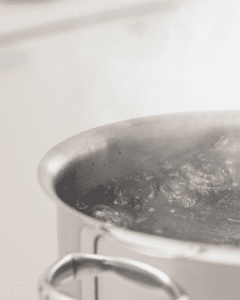
A full boil means boiling the entire volume of wort that will go into the fermenter. For a typical five-gallon batch, this usually means boiling 6 to 6.5 gallons of wort to account for evaporation during the boil. In a full boil, all ingredients (malt, hops, and water) are combined in the kettle and boiled together for the full brewing process.
Full boils are most common for brewers using:
- larger kettles
- propane burners
- outdoor brewing setups
What Is a Partial Boil?
A partial boil uses a smaller kettle and less water during the boil. In this method, the brewer adds all or most of the malt extract to a smaller volume of water, usually around 2–3 gallons, and performs the normal boil with hops. After the boil is finished, the concentrated wort is transferred to the fermenter and diluted with additional cool water until the final batch volume is reached.
Partial boils are often used by brewers who:
- have smaller stovetop kettles
- brew indoors
- live in apartments or small spaces
This method allows brewers to produce full batches without large equipment.
Pros and Cons of Partial Boils
Partial boils have helped many people get started in homebrewing because they are simple and accessible. This is exactly how I started because I was brewing in the kitchen in a 5 gallon pot.
Advantages
- Smaller equipment requirements
- Easy stovetop brewing
- Lower cost for starting equipment
- Convenient for apartment brewing
Downsides
- Boil overs are VERY likely to occur at the protein break … do NOT take your eyes off of it when it gets up toward 200° !!
- Adding water to get the wort from 3 gallons up to 6 could be a source of contaminants. Be sure your top-up water is sanitized and chlorine-free
Many successful batches of beer have been brewed using partial boils, especially when using liquid malt extract (LME) or dry malt extract (DME). With good sanitation and fermentation practices, the results can be very enjoyable.
Pros and Cons of Full Boils
Advantages
- Better hop utilization .. when hops are boiled in a larger volume of wort, their bitterness compounds dissolve more efficiently. This leads to more predictable hop bitterness and aroma.
- Improved color .. concentrated partial boils can sometimes lead to darker wort due to caramelization of sugars. Full boils reduce this effect and help maintain the intended color of the beer.
- Stronger sanitation .. a full boil ensures that all brewing water has been boiled, which eliminates microorganisms and improves overall sanitation.
- More consistent flavor .. because dilution happens before fermentation rather than after boiling, the final wort composition tends to be more uniform.
Downsides
- Larger kettles require larger heat sources, which pretty much eliminates the kitchen stove. An outdoor gas stove or electric kettle is the best solution.
- Without the right ports, pumps, tubing, etc, moving and chilling large quantities of hot wort becomes a safety concern.
Tips for Partial Boil Brewers
If you are brewing with a smaller kettle, a few adjustments can improve your results:
- As the wort heats, it will expand .. be sure to leave some headspace in the kettle for the extra volume.
- If boilovers become a problem, try using a foam control additive like FoamAxe or Fermcap, a silicone-based surfactant that keeps the proteins from coagulating.
- Adding part of the malt extract during the last 10–15 minutes helps prevent excessive darkening and improves hop utilization.
- If you are topping up the fermenter with additional water, make sure it is clean and free of chlorine or chloramine, which can affect flavor.
- After adding top-off water, gently stir the wort so the sugars are evenly distributed before measuring with a hydrometer.
Moving From Partial to Full Boils
Many brewers begin with partial boils and later transition to full boils as their equipment grows. Upgrading to a larger brew kettle or outdoor burner allows brewers to handle larger volumes of wort and take advantage of the benefits of full boiling. It is important to remember that great beer can be made with either method. The key factors remain good sanitation, healthy yeast, proper fermentation temperature, and careful measurement.
Choosing the Method That Fits Your Setup
The purpose of our Homebrew Skills Tree is to help brewers understand where they are in their brewing journey and what skills to develop next. Partial boiling is often a practical and effective starting point. Full boiling offers additional advantages once brewers expand their equipment and brewing space. Both approaches teach valuable lessons about brewing technique and ease (or complication) of your brewery setup.
As we progress upward through the Skills Tree, understanding how these process choices affect the final beer becomes another step toward brewing with confidence and control.
Here are some links to our different kettles.
Cheers!
Grain Honey Yeast SCOBYs Hops Nutrients Flavorings Fermenters Equipment Kits