
 Yeast Nutrients: When Yeast Need Help (and When They Don’t)
As we continue climbing the Homebrew Skills Tree, we’re moving beyond simply creating the right environment for fermentation and starting to understand what yeast actually needs to thrive.
Over the past several weeks, we’ve discussed sanitation, oxygen, temperature control, yeast health, and measuring fermentation. Now we arrive at another important topic: nutrition. Just like people, yeast needs more than calories to perform well. Sugar provides energy, but healthy fermentation also requires vitamins, minerals, and nitrogen. Understanding yeast nutrition helps brewers produce cleaner fermentations, avoid stuck fermentations, and create healthier yeast populations.
Sugar Is Food, But Not Complete Nutrition
Many new brewers assume that if yeast has sugar, it has everything it needs. That’s only partly true. Sugar provides energy, but yeast also needs building materials to reproduce, build cell membranes, repair cellular damage, and produce enzymes. One of the most important of these building materials is nitrogen. Without adequate nitrogen, yeast can become stressed and fermentation performance may suffer.
The Role of Nitrogen
Nitrogen is one of the primary nutrients yeast uses to build proteins and reproduce. In brewing, the most important form is often called FAN — Free Amino Nitrogen. FAN consists of amino acids and other nitrogen-containing compounds that yeast can easily absorb and use. Think of FAN as the yeast equivalent of dietary protein. Healthy levels of FAN help yeast reproduce efficiently, ferment completely, tolerate alcohol stress, produce cleaner flavors. When FAN levels are insufficient, yeast may struggle to complete fermentation.
Why Beer Usually Has Enough Nutrients
One reason beer fermentation is often forgiving is that malted grain naturally contains many of the nutrients yeast needs. A typical wort provides FAN, vitamins, minerals, and trace nutrients. As a result, most standard beer fermentations do not require large nutrient additions. If the wort is healthy and the yeast pitch is adequate, fermentation usually proceeds successfully.
Why Mead and Cider Often Need Nutrients
However, honey and fruit juices are different. While they contain plenty of fermentable sugar, they often contain far less nitrogen and fewer yeast-supporting nutrients than wort. This is one reason why mead and cider makers frequently use nutrient additions. Without supplementation, yeast may experience slow starts, sluggish fermentation, sulfur production, and incomplete attenuation. Proper nutrient management has become one of the most important skills in modern meadmaking.
Oxygen and Nitrogen Work Together
In earlier Skills Tree lessons, we learned that yeast needs oxygen during the early growth phase of fermentation. Oxygen helps yeast build strong cell membranes. Nitrogen helps yeast build proteins and new cells. Together, oxygen and nitrogen support healthy yeast growth during the aerobic phase. Once oxygen is depleted, fermentation shifts into the anaerobic phase where alcohol production becomes the primary activity. This is why we focus on oxygen early, nutrient availability early, and oxygen avoidance later.
Common Forms of Yeast Nutrients
There are several types of nutrient products (product links below). Each provides slightly different benefits.
Inorganic Nutrients (DAP)
One common nutrient is Diammonium Phosphate (DAP). DAP provides nitrogen in a simple, easily absorbed form.
Advantages:
- inexpensive
- highly effective
- widely available
Limitations:
- provides mostly nitrogen
- lacks vitamins and other micronutrients
Many nutrient blends include DAP as one component rather than relying on it exclusively.
Organic Nutrients
Modern nutrient products increasingly rely on organic nitrogen sources. These often come from yeast derivatives, amino acids, and yeast hulls. Organic nutrients tend to provide a broader range of nutrition and are often gentler on fermentation. Many meadmakers find that organic nutrient programs produce cleaner fermentations, lower stress, and fewer sulfur compounds.
Dehydrated Yeast Nutrients
Some products are made from inactive yeast cells. Examples include yeast hulls, autolyzed yeast products, and products such as Servomyces. These provide amino acids, minerals, micronutrients, and cell wall components. In many ways, they act as a nutritional supplement made from yeast itself.
Liquid Nutrient Products
Some nutrient products are sold in liquid form and contain a blend of nutrients designed to support fermentation. These are particularly common in wine making, mead making, and commercial fermentation. The liquid format can simplify dosing and mixing.
Nutrients for Yeast Starters
Yeast starters are another situation where nutrients can be beneficial. The goal of a starter is not alcohol production. The goal is yeast growth. Products such as Omega Propper Starter Nutrient are designed specifically to support yeast reproduction during starter preparation. By providing additional nutrients, these products help yeast build strong, healthy populations before pitching into the main batch.
Can You Add Too Much Nutrient?
Yes. More nutrient is not always better. Excessive additions may create unwanted flavors, stress yeast in other ways, or leave residual nutrient compounds in the finished beverage. Following manufacturer recommendations is usually the best approach. As we gain experience, we can refine nutrient schedules based on fermentation type and yeast strain.
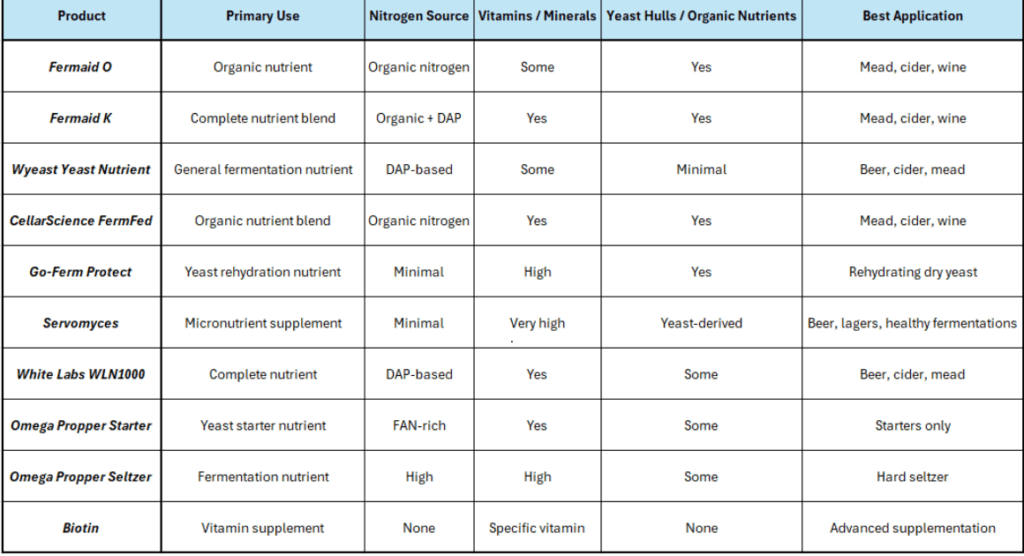
See Them Side-by-Side
Here’s a comparison table of the yeast nutrient products that we carry at North Texas Homebrew.
A Skill That Connects Many Others
Yeast nutrition sits at an interesting point on the Homebrew Skills Tree because it connects many topics we’ve already discussed. Healthy fermentation depends on proper oxygenation, good temperature control, sufficient nutrients, and healthy yeast populations. When all of these factors work together, yeast performs efficiently and predictably. And that’s ultimately the goal of every brewer: creating an environment where the yeast can do its best work.
The better we understand what yeast needs, the better our fermentation will become.
Here are some links to yeast nutrient products at NTHBS.
Cheers!