


 Grain, Milling, and Brewhouse Efficiency
If yeast is the engine of fermentation, grain is the fuel. Every kernel of barley, wheat, rye, oats, corn, spelt, rice or other grains contains a complex package of starches, proteins, lipids, minerals, enzymes, and flavor compounds that contribute to the finished beer. Before mashing can begin, those nutrients must be made accessible. That’s where milling comes in.
What’s Inside a Grain Kernel?
A grain kernel contains several important components:
Starch (Polysaccharides): Starch is the primary energy reserve of the grain and represents the largest source of fermentable extract. During the mash, enzymes break starch into smaller sugars: Glucose, Maltose, Maltotriose, Dextrins. Yeast readily ferments the simple sugars while dextrins contribute body and mouthfeel.
Enzymes: Malted grains contain enzymes developed during germination. The two most important are Alpha amylase and Beta amylase. These enzymes convert starch into fermentable sugars during the mash. Without sufficient enzyme activity, starch remains inaccessible and efficiency suffers. Some grains, like corn, have very low levels of enzymes, so mashing them doesn’t do anything toward breaking down their sugars into fermentables. So, sometimes, brewers must add supplemental enzymes to enable the target breakdown of complex starches into fermentable sugars.
Proteins: Proteins contribute head retention, mouthfeel, yeast nutrition, and foam stability. Proteins are also broken into amino acids and peptides during malting and mashing. These compounds provide Free Amino Nitrogen (FAN), one of yeast’s most important nutrient sources.
Lipids (Fats and Oils): Lipids are present in small quantities. They are important for yeast cell membrane health but excessive lipids can reduce foam stability, increase staling reactions, and create flavor instability. Fortunately, most remain behind in the spent grain.
Husk Material: The husk is particularly important. In your mash, it provides natural filtration, lauter bed structure, and wort drainage pathways. This is why barley is generally easier to lauter (rinse and separate the sugar from the mashed grain) than huskless grains such as wheat or rye; the huskless grains don’t have as much bulky fiber so tend to clog the false bottom or other filters that help clarify the wort when it’s transferred to the fermenter.
Why Do We Mill Grain?
The starches and enzymes are located inside the kernel. If whole kernels are mashed without milling, water cannot efficiently access those materials, so there won’t be any fermentable sugar for the yeast to process. Milling serves three purposes: expose the starch-containing endosperm, increase surface area for enzyme activity, and preserve enough husk structure for effective lautering. Good milling balances extraction and filtration.
What Happens If Grain Is Crushed Too Coarsely?
When kernels are only partially broken, you get a lower extract yield, lower mash efficiency, reduced brewhouse efficiency, and probably lower original gravity. That is, the warm water won’t be able to break down the fats and proteins, and won’t activate the enzymes so that they’ll convert the sugars from non-fermentables to fermentable! So, you might have expected an initial gravity of 1.048, but many of the starches remain trapped inside intact kernel fragments and never participate in conversion.
Symptoms include: lower-than-expected gravity, intact kernels visible in spent grain, and consistently poor efficiency.
What Happens If Grain Is Crushed Too Finely?
Over-crushing creates excessive flour. Instead of the hulls providing a filter layer at the bottom where the rest of the kernel contents will get caught, the powdery meat goes past the husks and gums up the holes in the false bottom or filter. Potential consequences include: stuck sparges, slow runoff, compacted grain beds, increased tannin extraction risk, and reduced wort flow. In extreme cases the mash resembles wet cement rather than a filter bed. A finer crush often increases efficiency (ie you’ll get higher sugar content) but eventually reaches a point where lautering performance deteriorates. The highest efficiency crush is not always the best crush.
Diastatic Power: The Grain’s Enzyme Reserve
Diastatic Power (DP) measures the enzymatic strength of malt; the grain enzyme’s ability to convert starch into sugar. Higher DP malts can convert both their own starches and the starches of adjunct grains. A few examples of diastatic power include:
- American 6-row: very high DP
- American 2-row: moderate-high DP
- Pilsner malt: moderate-high DP
- Munich malt: lower DP
- Crystal malts: essentially zero DP
- Roasted malts: essentially zero DP
Adjuncts such as flaked corn, flaked oats, flaked wheat, and rice contain starch but little or no enzymatic power. These grains rely on base malt enzymes for conversion.
Flaked vs Torrified Grains
These products are often confused. Flaked grains are steam conditioned and rolled flat between heated rollers. Examples include:
- Flaked oats
- Flaked wheat
- Flaked corn
- Flaked barley
The process gelatinizes starches and makes them mash-ready. They can usually be added directly to the mash, ie they don’t need to be milled.
Torrified Grains
Torrification rapidly heats grain using high temperature air. The kernel “pops” and expands (think corn pops).
This process gelatinizes starch, improves accessibility, and retains more kernel structure.
Common examples include:
- Torrified wheat
- Torrified barley
Torrified grains often contribute improved foam stability and body while remaining mash-ready.
Types of Grain Mills
Two-roller mills are the most common homebrew mill. They are affordable, adjustable, and reliable. Grain passes between two knurled rollers that bust open the kernel while pulling it through to the output.
Three-roller mills add a preliminary crushing stage. Their advantage is a more consistent crush, better husk preservation, and higher efficiency potential. These are popular among advanced homebrewers, and are somewhat more expensive.
Hand-cranked mills are usually two-roller designs powered manually. They are relatively low cost and no electricity required. But, for more than 5-10 pounds of grain, they are slow and a lot of exercise.
Motorized mills can be purpose-built or driven by a drill. They are fast, consistent, and reduced labor compared to the hand-crank models. These are common and required in high-volume brew systems. The motor for these mills is a bit specialized and typically costs about as much as the mill itself.
Professional breweries may use multi-stage roller mills (3-6 or multi-pass rollers), wet mills (gets the husk a little wet so it doesn’t splinter into tiny pieces but still allows the meat to be crushed, yields good filter material but fine grits).
Potential Efficiency vs Actual Efficiency
Every malt has a theoretical maximum amount of extract available. Laboratories measure this under ideal conditions. This is the malt’s potential. If everything was perfect, this is how much sugar you would get out of this grain.
Mash efficiency measures how much of that potential was extracted into the kettle. Factors include crush quality, mash pH, mash temperature, conversion completeness, and lautering performance.
Brewhouse efficiency considers everything that happens from grain to fermenter. Losses include dead space, trub, transfer losses, and boil losses. Brewhouse efficiency is always lower than mash efficiency.
Milling Influences More Than Efficiency
The grain crush affects:
Attenuation – better starch access often increases fermentability.
Body and Mouthfeel – different mash and crush conditions influence dextrin production and extraction.
Lautering Speed – crush directly impacts runoff performance.
Wort Clarity – excessive flour can increase haze and trub load.
Tannin Extraction Risk – over-processing husks may increase extraction of polyphenols under poor sparging conditions.
Process Consistency – consistent crush leads to consistent beer.
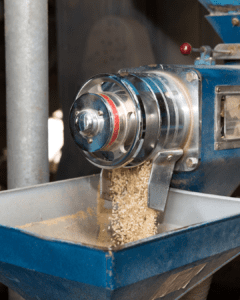
The Grits – the little bits of disintegrated grain that you get after it’s milled 😉
A brewer’s mill is more than a grain crusher. It is one of the most important process-control tools in the brewery. The goal is not the finest crush possible or the highest efficiency possible. The goal is a repeatable crush that exposes the endosperm, preserves husk structure, supports healthy conversion, and produces predictable, high-quality wort every time.
Like so many of our homebrew skills tree topics .. great beer begins long before fermentation starts. Grain is a critical part of great homebrew.
Our mill at NTHBS has been tuned to produce a great crush; enough hull to support lautering, but not so much that the endosperm is turned to flour. Please stop by if you want to check it out and learn how to set the gap on your home mill.
Here are some links to milling products at NTHBS.
Cheers!