


 Homebrew Skills Tree – Week 2
Cleaning and Sanitizing: The Roots of Good Fermentation
In the Homebrew Skills Tree, every skill builds on the ones below it. The skills near the bottom of the tree are usually the simplest to learn, but they are also some of the most important. As brewers move up the tree, the techniques become more complex and sometimes more time-consuming, but they allow greater control and better results.
One of the most important foundation skills is cleaning and sanitizing. If these steps are done well, fermentation usually proceeds smoothly. If they are skipped or done poorly, even the best ingredients and recipes may not produce the result you expect. For that reason, cleaning and sanitizing sit right at the roots of the Skills Tree.
Many brewers start by focusing on:
- cleaning and sanitation
- basic measurements
- simple fermentation management
These are relatively easy skills to learn, but they make an enormous difference in consistency. Once these foundations are strong, brewers can move upward into more advanced techniques such as yeast management, water chemistry, and flavor control. A healthy tree starts with strong roots!
Cleaning vs. Sanitizing
Although people often use the words interchangeably, cleaning and sanitizing are two different steps. Both are necessary.
Cleaning
Cleaning means removing visible residue such as dried yeast, hop particles, honey, or fruit pulp. This step usually involves warm water and a cleaning product such as:
Cleaning removes the materials that microorganisms can grow on. If equipment is not cleaned first, sanitizers cannot work effectively.
Sanitizing
Sanitizing happens after cleaning. Sanitizing reduces microorganisms to levels that are unlikely to interfere with fermentation, like staph0l0coccus, lactobacillus, acetobacter, and others. Sanitizers are designed to work quickly and leave minimal residue. Common homebrewing sanitizers include:
These products are widely used because they are effective and easy to apply. Unlike cleaning agents, sanitizers are not meant to remove debris. They simply create an environment where unwanted microbes cannot compete with your yeast.
Why This Matters in Fermentation
During fermentation, yeast converts sugars into alcohol and carbon dioxide. But yeast is not the only microorganism that enjoys sugar-rich environments. Wild yeast and bacteria are everywhere in nature. If they find their way into your fermentation vessel, they may create unwanted flavors or spoil a batch entirely. These off-flavors can appear as:
- sour or vinegary notes
- plastic or medicinal aromas
- unusual cloudiness or haze
Proper cleaning and sanitizing dramatically reduces these risks. Fortunately, the process is straightforward and becomes routine with practice.
A Simple Sanitation Routine
A good habit is to sanitize anything that will touch your wort, must, cider, or finished beverage after boiling or mixing. This usually includes:
- hands
- fermenters
- airlocks
- funnels
- spoons
- siphons
- hydrometers
- bottles and caps
- pumps and tubing
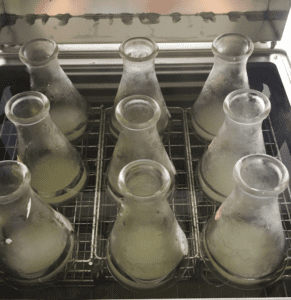
- yeast starter flasks (yep, I missed this one once!)
Many brewers keep a small bucket of diluted Star San nearby during brew day so tools can be sanitized quickly as needed. It is also helpful to remember that sanitizers typically require contact time to work properly. Allowing equipment to remain wet with sanitizer for a short period ensures the solution can do its job. Most homebrew sanitizers do NOT need to be rinsed .. in fact, rinsing them with tap or hose water may be re-introducing bacteria that you just killed off with the sanitizer!
Building Confidence Through Routine
Once brewers develop a consistent cleaning and sanitation routine, it quickly becomes second nature.
Most batches that develop unexpected flavors can often be traced back to either sanitation issues or fermentation control. By mastering sanitation early in the Skills Tree, brewers remove one of the most common sources of problems. As you move further up the Skills Tree, you will encounter techniques that involve more detailed measurements, ingredient adjustments, and fermentation management. These advanced skills demand that bacteria and wild yeast are not allowed to be part of the equation.
Cleaning and sanitizing may seem basic, but they are one of the most valuable skills a brewer can learn. With strong roots and some good habits, the rest of the tree can grow with confidence.
Cheers!
Grain Honey Yeast SCOBYs Hops Nutrients Flavorings Fermenters Equipment Kits